Here in the US, Black history month ended and women’s history month has just started – time for a blog! A lot of dreary things are happening: this week, the bombing of Iran by the Unites States and Israel. The Iranian regime has killed so many of its own; and now, after only a few days of this war, many civilians – including schoolgirls – have been murdered in Iran. And there are casualties elsewhere. It remains important to say: Bombing another country into regime change is not an act of self-defense, and it is illegal under international law.
I feel a deep sense of disorientation in such moments. It is more than just despair. I wonder if it is even possible in the current circumstances to do something that contributes to a world that I would like to live in, one that is fair, nurturing, and caring for all. I often have an inner conversation with myself where one side insistently tells the other that teaching critical thinking, feminism, human rights, postcolonialism and so on really goes in that direction. Sometimes, this does not sound convincing. Other times, I get more hopeful.
If you share this feeling of resignation, I write this blog for you (as much as for myself) with a message: the most important thing, even if we feel we don’t have much influence, is to continuously do something that puts our ideals into practice and do it together with others. These may be small things, but if we see them accumulate, the picture changes. I have recently experienced a collective moment like that which I am going to share, but first, let me tell you where I am coming from.
As a feminist scholar-activist, the ideal I work for is gender justice. I have seen my share of devaluation of feminist ideas in public discourses but also experienced great spaces for feminist thinking, action, and solidarity, within and outside of academia. I grew up in West- and then unified Germany, where I benefited from some rights that feminists had fought hard for, such as the constitutional recognition of gender equality achieved in 1949 (thank you to Elisabeth Selbert, one of the four “mothers of the basic law”, for that). My parents never doubted that their son and daughters should have the exact same educational opportunities, and I credit many of my high school teachers for supporting girls as much as boys. Interestingly, I first became intimidated by male voices and internalized that they count more in college. To this day, I sometimes feel unheard or make my voice small.
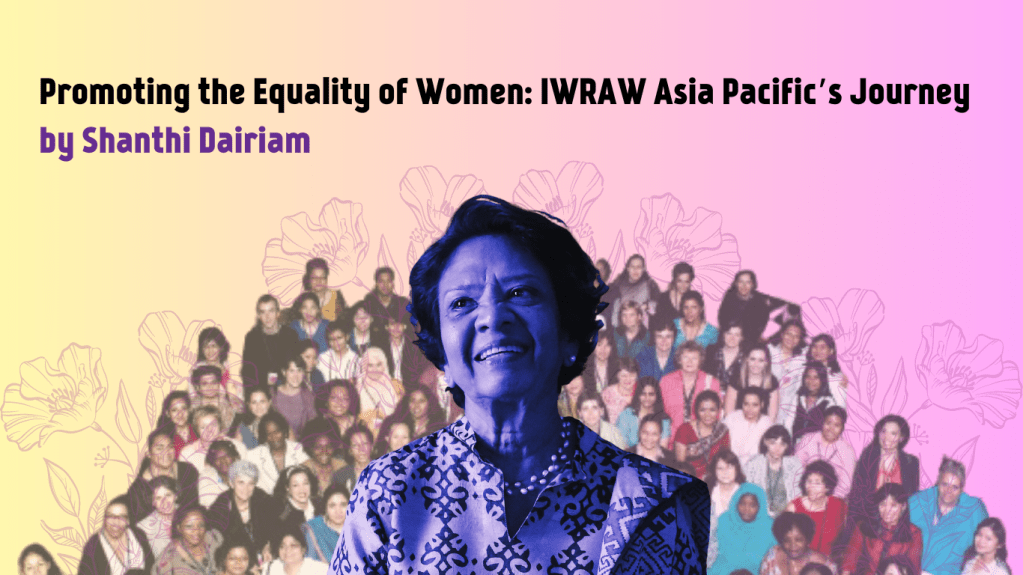
Feminism helped me see these things, question them, together with other women and a few men. I learned about strategies and successes of women’s activists in many countries, often achieved against immense obstacles. I study how feminists from different countries have collaborated, despite disagreements, to change normalized patriarchy and other forms of oppression around the globe. Shout-out to one of them, Shanthi Dairiam, who dedicated her life to the realization of women’s rights (see her institutional biography of the organization she founded, IWRAW Asia-Pacific).
These manifold efforts have made women’s lives more dignified in SO many ways. Among other things, feminist interventions have helped make women more economically independent and reduce maternal mortality (which remains far too high). It is also a huge step forward that gender-based violence is now better recognized as a structural and global form of violence. However, the current debate on the Epstein files shows that the desire of men to dominate and objectify women, to the degree that they sexually exploit children and even feel entitled to do this, has not gone away. Patriarchy is highly adaptable – I agree with Celeste Davis that even the most outrageous forms of sexual violence are committed in the midst of supposedly normal, “civilized” societies. In her blogpost, she brings together the people involved with Epstein and the ones who drugged and raped Gisele Pelicot.
During my career, I moved from Germany to the United States, embracing a transnational life. I found feminism more present and unapologetic here than in Germany, as well as internally diverse and sometimes divided. The fact that I got a JOB – two, actually – to research and teach feminism in International Relations felt fantastic – my life passion validated. I still don’t think that feminist ideas are heard (and put into practice) as much as they should, but until about a decade ago, I felt they were widely considered as contributing to a worthy goal: gender justice.
Since then, voices that want to put an end to that goal have gotten SO MUCH stronger. As I study feminism in different settings, the obstacles activists are up against have always been clear to me because FEMINISM IS A THREAT TO THOSE WHO BENEFIT FROM GENDER HIERARCHIES (like, all those powerful people in the Epstein files, writes Joan Scott). Still, it is dazzling to see how radically the tide has turned and how many feminist gains are under attack; the attackers have moved from marginal incel spaces into the mainstream of societies worldwide. The manosphere and the most powerful (mostly male) people on earth have become indistinguishable.
At the center of these attacks is the study of women, gender and sexuality. I am surprised to be considered that dangerous, but I should not be. Knowledge is power. We get constant news from Women’s and Gender studies centers and programs being closed; in Florida, this trend started in 2023 with New College; more recently, there have been closures or mergers of programs, or dissolution of departments, such as at Texas A&M, Wichita State University in Kansas, and Townson University in Maryland. The trend did not start in the United States: The Hungarian government withdrew the accreditation of Central European University’s Women’s and Gender Studies program as early as 2018. I am sure that people in Florida politics were watching closely at that time. When they started their assault on academic freedom, they used the same patriarchal populist rhetoric to vilify what they call “gender ideology” without having the faintest clue about gender-related research.
In sum: those of us who do feminism are used to criticisms and accusations; it is just that it has both gotten so much more existential (are our jobs on the line?) AND baseless, as far as knowledge-based engagement is concerned. But after some time of feeling intimidated, I have come to a reassuring conclusion: feminist thinking is not going away. It has been around for so long – here in the US, the first women’s studies program was launched at San Diego State University in 1970, and as of 2023 more than 800 such departments and programs existed, according to data from the National Women’s Studies Association. Even if many of these are being closed – and that is a HUGE loss – the field is firmly established and will continue to influence how we see society and how to transform it. We can take a stance of courage and responsibility, I think: We will be the ones who keep this discourse and practice alive, in our many different ways. Think of feminism as a collective effort, a huge tapestry into which we all weave our threads. That way, the tapestry might rip here and there, but together, we keep it present, beautiful and strong.
Let me give you just three examples of such feminist threads. #1: In February, I attended a conference organized by the Department of Women’s, Gender and Sexuality Studies at the University of South Florida. It was the first such conference I experienced in Florida, where feminist and queer studies scholars and students from different institutions came together. In the current hostile climate towards academic freedom, it was a political act to have this conference and enable us attendees to see and learn from each other. The meeting offered a tremendous boost of hope, validation and energy. Thank you, USF!!!
#2: At this conference, I spoke about an activity I am involved in – an online event series we call Florida Feminist Fridays (FFF for short). It has its origin in a conference I co-organized in 2023 – longstanding blog readers may recall it, as I mentioned it here – about transnational feminism. The conference wanted to create a space to amplify feminist voices in response to multiple global crises; and it wanted to create this space right here in Florida, because we need good feminist ideas and strategies to stand up against the onslaught against academic freedom and everything I described above. So, to carry the momentum of that wonderful conference, a small team got together and created the FFFs. Since fall 2023, we have organized between one and three events per semester and invited either individual speakers or created collective conversations on gender-related issues relevant to Florida, including: campaigns to preserve reproductive justice (thank you in particular to the “Yes on amendment 4” leaders Anna Hochkammer, Sarah Parker and Natasha Sutherland for joining us); attacks on academic freedom and diversity, equity, and inclusion (DEI) initiatives at our universities and elsewhere (our first speaker in fall 2023 actually joined us from Hungary, to share her analysis of the dismantling of gender studies at Central European University mentioned above – what a great kick-off, Andrea Krizsan!); and a comprehensive plan to understand and eliminate gender-based violence in Miami-Dade County (thank you to Rosario Concha of the COURAGE in our County – Miami Dade Safety Project). The groups that have come together to learn about and discuss these issues include university faculty and staff, students, and community activists, and each of the meetings created a space of learning, solidarity, and a dynamic that helps us “keep going”. It makes me proud to create such spaces! Also, send me an email at szwingel@fiu.edu if you want to be added to the FFF listserv to be informed about future events).
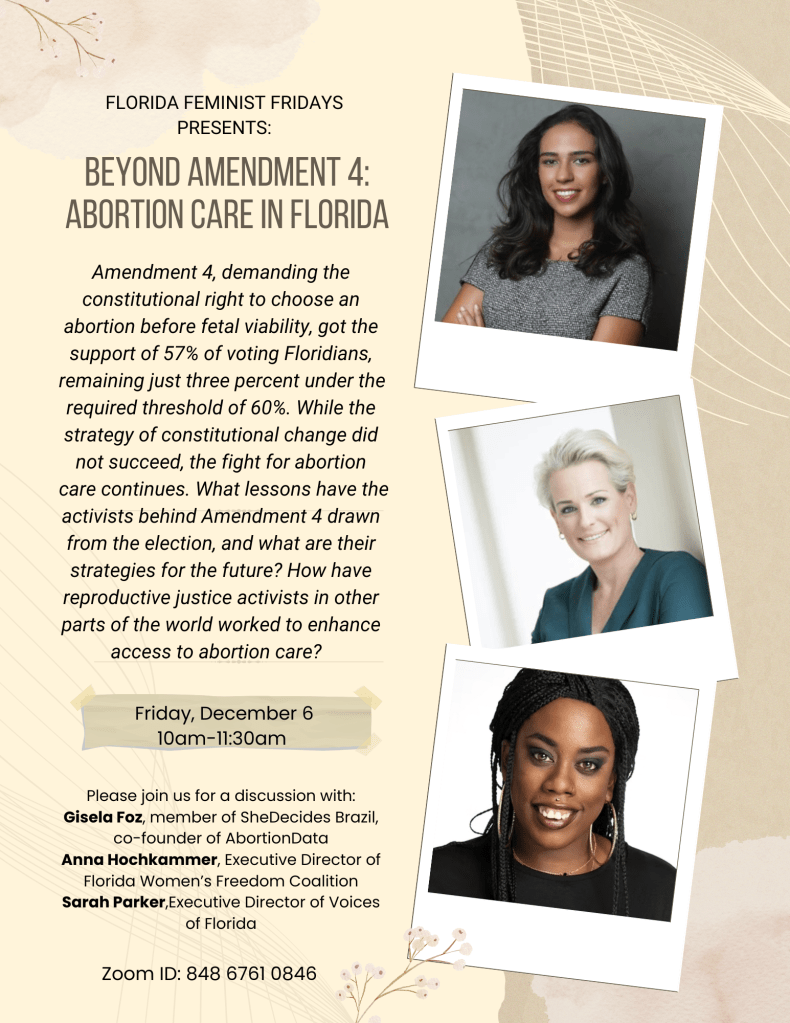
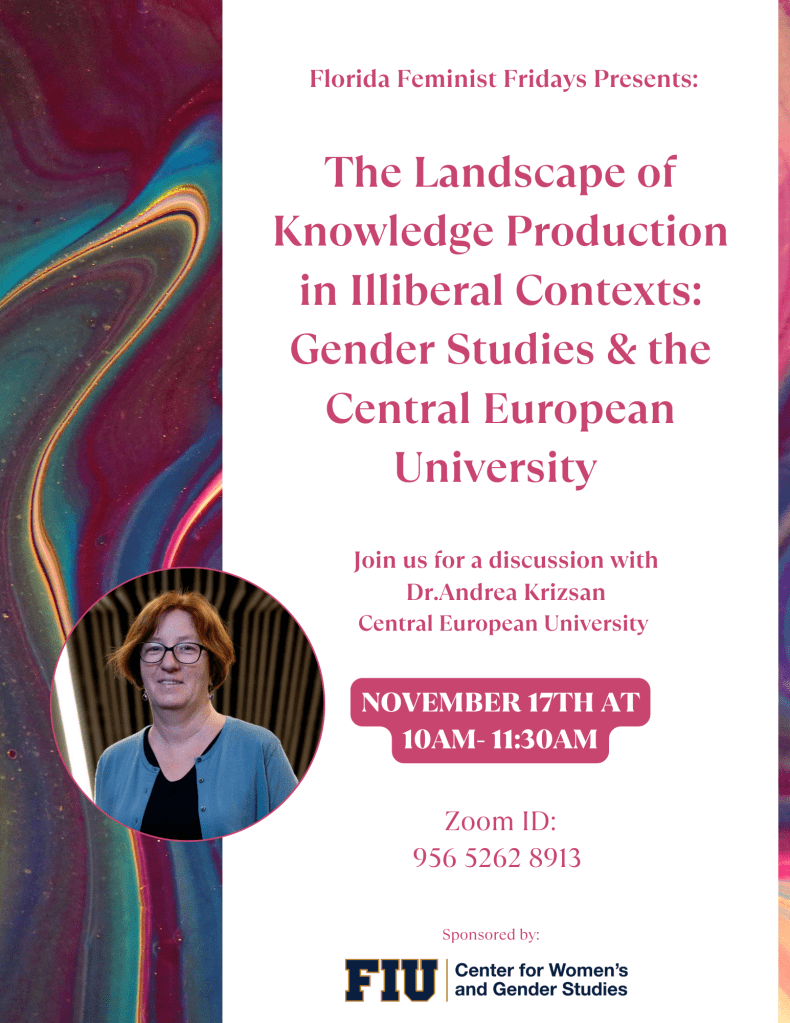

Just three of our faboulous FFF events!
#3: I recently learned about a really cool magazine called Lux, self-described as A Socialist Feminist Mag for the Masses. It’s Sex, With Class”. Check it out! The editor-in-chief, Sarah Leonhard, also attended the USF conference while on a college tour to report on student activism in the country. I am looking forward to that story! And became a subscriber.
These are pretty random “feminist threads”. They just happened to come together for me and gave me a boost. I hope you have many others in your own spaces and would love to hear about them!
Have a GREAT, inspired, women’s history month/ international women’s day!

 The common sense feminist