Of disorientation, hope, and weaving feminist threads

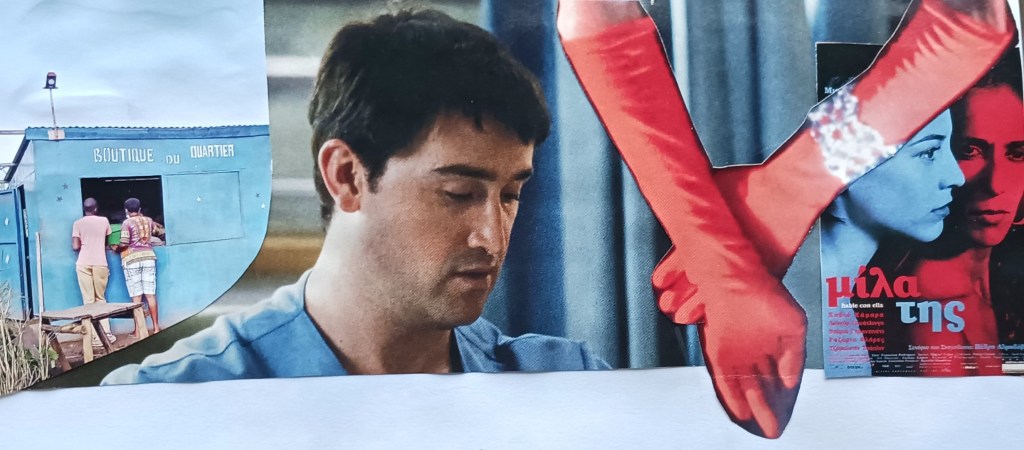
An Almodovar-inspired collage – arts projects are good for my sanity!

Here in the US, Black history month ended and women’s history month has just started – time for a blog! A lot of dreary things are happening: this week, the bombing of Iran by the Unites States and Israel. The Iranian regime has killed so many of its own; and now, after only a few days of this war, many civilians – including schoolgirls – have been murdered in Iran. And there are casualties elsewhere. It remains important to say: Bombing another country into regime change is not an act of self-defense, and it is illegal under international law.   

I feel a deep sense of disorientation in such moments. It is more than just despair. I wonder if it is even possible in the current circumstances to do something that contributes to a world that I would like to live in, one that is fair, nurturing, and caring for all. I often have an inner conversation with myself where one side insistently tells the other that teaching critical thinking, feminism, human rights, postcolonialism and so on really goes in that direction. Sometimes, this does not sound convincing. Other times, I get more hopeful.  

If you share this feeling of resignation, I write this blog for you (as much as for myself) with a message: the most important thing, even if we feel we don’t have much influence, is to continuously do something that puts our ideals into practice and do it together with others. These may be small things, but if we see them accumulate, the picture changes. I have recently experienced a collective moment like that which I am going to share, but first, let me tell you where I am coming from.    

As a feminist scholar-activist, the ideal I work for is gender justice. I have seen my share of devaluation of feminist ideas in public discourses but also experienced great spaces for feminist thinking, action, and solidarity, within and outside of academia. I grew up in West- and then unified Germany, where I benefited from some rights that feminists had fought hard for, such as the constitutional recognition of gender equality achieved in 1949 (thank you to Elisabeth Selbert, one of the four “mothers of the basic law”, for that). My parents never doubted that their son and daughters should have the exact same educational opportunities, and I credit many of my high school teachers for supporting girls as much as boys. Interestingly, I first became intimidated by male voices and internalized that they count more in college. To this day, I sometimes feel unheard or make my voice small.   

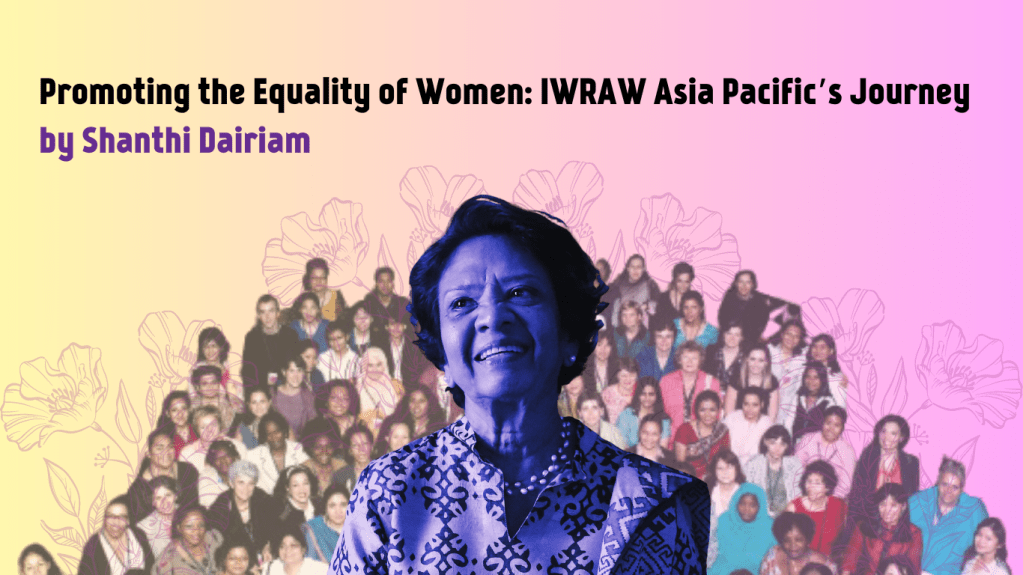
Feminism helped me see these things, question them, together with other women and a few men. I learned about strategies and successes of women’s activists in many countries, often achieved against immense obstacles. I study how feminists from different countries have collaborated, despite disagreements, to change normalized patriarchy and other forms of oppression around the globe. Shout-out to one of them, Shanthi Dairiam, who dedicated her life to the realization of women’s rights (see her institutional biography of the organization she founded, IWRAW Asia-Pacific).
These manifold efforts have made women’s lives more dignified in SO many ways. Among other things, feminist interventions have helped make women more economically independent and reduce maternal mortality (which remains far too high). It is also a huge step forward that gender-based violence is now better recognized as a structural and global form of violence. However, the current debate on the Epstein files shows that the desire of men to dominate and objectify women, to the degree that they sexually exploit children and even feel entitled to do this, has not gone away. Patriarchy is highly adaptable – I agree with Celeste Davis that even the most outrageous forms of sexual violence are committed in the midst of supposedly normal, “civilized” societies. In her blogpost, she brings together the people involved with Epstein and the ones who drugged and raped Gisele Pelicot.  

During my career, I moved from Germany to the United States, embracing a transnational life. I found feminism more present and unapologetic here than in Germany, as well as internally diverse and sometimes divided. The fact that I got a JOB – two, actually – to research and teach feminism in International Relations felt fantastic – my life passion validated. I still don’t think that feminist ideas are heard (and put into practice) as much as they should, but until about a decade ago, I felt they were widely considered as contributing to a worthy goal: gender justice.     

Since then, voices that want to put an end to that goal have gotten SO MUCH stronger. As I study feminism in different settings, the obstacles activists are up against have always been clear to me because FEMINISM IS A THREAT TO THOSE WHO BENEFIT FROM GENDER HIERARCHIES (like, all those powerful people in the Epstein files, writes Joan Scott). Still, it is dazzling to see how radically the tide has turned and how many feminist gains are under attack; the attackers have moved from marginal incel spaces into the mainstream of societies worldwide. The manosphere and the most powerful (mostly male) people on earth have become indistinguishable.    

At the center of these attacks is the study of women, gender and sexuality. I am surprised to be considered that dangerous, but I should not be. Knowledge is power. We get constant news from Women’s and Gender studies centers and programs being closed; in Florida, this trend started in 2023 with New College; more recently, there have been closures or mergers of programs, or dissolution of departments, such as at Texas A&M, Wichita State University in Kansas, and Townson University in Maryland. The trend did not start in the United States: The Hungarian government withdrew the accreditation of Central European University’s Women’s and Gender Studies program as early as 2018. I am sure that people in Florida politics were watching closely at that time. When they started their assault on academic freedom, they used the same patriarchal populist rhetoric to vilify what they call “gender ideology” without having the faintest clue about gender-related research.     

In sum: those of us who do feminism are used to criticisms and accusations; it is just that it has both gotten so much more existential (are our jobs on the line?) AND baseless, as far as knowledge-based engagement is concerned. But after some time of feeling intimidated, I have come to a reassuring conclusion: feminist thinking is not going away. It has been around for so long – here in the US, the first women’s studies program was launched at San Diego State University in 1970, and as of 2023 more than 800 such departments and programs existed, according to data from the National Women’s Studies Association. Even if many of these are being closed – and that is a HUGE loss – the field is firmly established and will continue to influence how we see society and how to transform it. We can take a stance of courage and responsibility, I think: We will be the ones who keep this discourse and practice alive, in our many different ways. Think of feminism as a collective effort, a huge tapestry into which we all weave our threads. That way, the tapestry might rip here and there, but together, we keep it present, beautiful and strong.

Let me give you just three examples of such feminist threads. #1: In February, I attended a conference organized by the Department of Women’s, Gender and Sexuality Studies at the University of South Florida. It was the first such conference I experienced in Florida, where feminist and queer studies scholars and students from different institutions came together. In the current hostile climate towards academic freedom, it was a political act to have this conference and enable us attendees to see and learn from each other. The meeting offered a tremendous boost of hope, validation and energy. Thank you, USF!!!

#2: At this conference, I spoke about an activity I am involved in – an online event series we call Florida Feminist Fridays (FFF for short). It has its origin in a conference I co-organized in 2023 – longstanding blog readers may recall it, as I mentioned it here – about transnational feminism. The conference wanted to create a space to amplify feminist voices in response to multiple global crises; and it wanted to create this space right here in Florida, because we need good feminist ideas and strategies to stand up against the onslaught against academic freedom and everything I described above. So, to carry the momentum of that wonderful conference, a small team got together and created the FFFs. Since fall 2023, we have organized between one and three events per semester and invited either individual speakers or created collective conversations on gender-related issues relevant to Florida, including: campaigns to preserve reproductive justice (thank you in particular to the “Yes on amendment 4” leaders Anna Hochkammer, Sarah Parker and Natasha Sutherland for joining us); attacks on academic freedom and diversity, equity, and inclusion (DEI) initiatives at our universities and elsewhere (our first speaker in fall 2023 actually joined us from Hungary, to share her analysis of the dismantling of gender studies at Central European University mentioned above – what a great kick-off, Andrea Krizsan!); and a comprehensive plan to understand and eliminate gender-based violence in Miami-Dade County (thank you to Rosario Concha of the COURAGE in our County – Miami Dade Safety Project). The groups that have come together to learn about and discuss these issues include university faculty and staff, students, and community activists, and each of the meetings created a space of learning, solidarity, and a dynamic that helps us “keep going”. It makes me proud to create such spaces! Also, send me an email at szwingel@fiu.edu if you want to be added to the FFF listserv to be informed about future events).
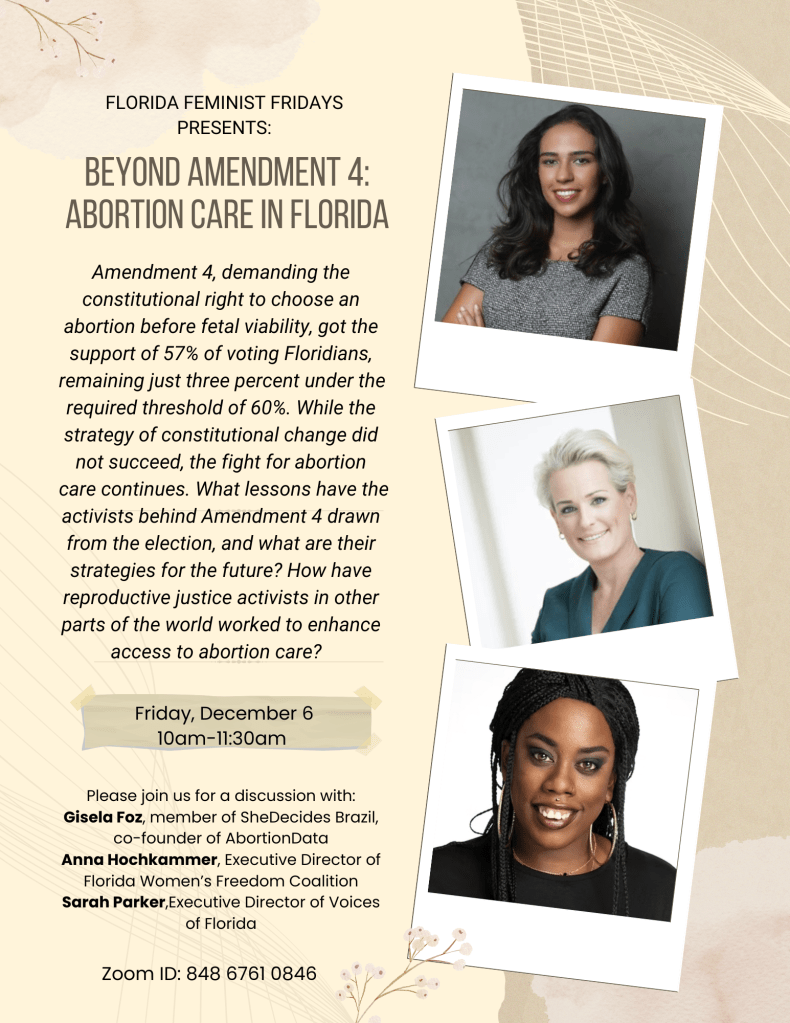
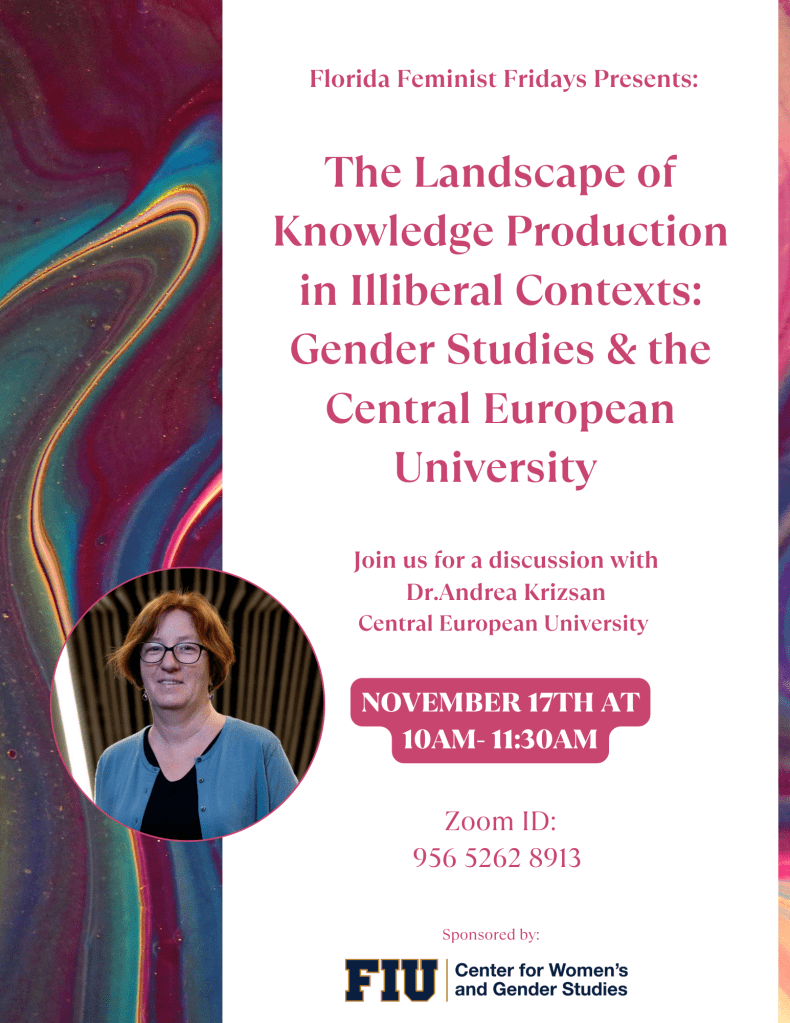
Just three of our faboulous FFF events!

#3: I recently learned about a really cool magazine called Lux, self-described as A Socialist Feminist Mag for the Masses. It’s Sex, With Class”. Check it out! The editor-in-chief, Sarah Leonhard, also attended the USF conference while on a college tour to report on student activism in the country. I am looking forward to that story! And became a subscriber.  

These are pretty random “feminist threads”. They just happened to come together for me and gave me a boost. I hope you have many others in your own spaces and would love to hear about them!

Have a GREAT, inspired, women’s history month/ international women’s day!  

An ode to teaching or: “For this, Sir, you are a monster”

Sprouting ginger root

I wish you all a happy and healthy 2025! I am very proud of myself for getting this blog out before the semester starts (which is, for us, tomorrow). This one is an ode to teaching. I just read my student evaluations from last semester, which were good, but as they often are, not GREAT (meaning: students had some things to praise, but also some complaints). Perhaps you are among the teachers who get “excellent” for all categories. I am not, and I can’t understand why I still give more weight to the one student who did not like the class (or me) rather than the ones who were happy, or more, with it. Coincidentally, two former students got in touch, and we had coffee on Friday – I am grateful that they found it important enough to meet me, and even seek advice.   

So, teaching is a mixed bag and comes with challenges. It is also what makes me most happy about my work. Let me share one teaching moment with you that made me hopeful. Yes, in times like these, we need such moments like bright stars in the dark. I do feel despair – about rising fascism, the indifference toward global climate disaster, rich white boys making everything that pleases them the law of the land – but the only antidote is creating collective spaces for thinking, talking, and respecting each other. At its best, teaching can do that.   

Last year, I taught a class on Gender Equality and Human Rights in Global Perspective. While the class was going on, a non-binary teenager died in Oklahoma. The case was in the headlines for a while because the death occurred one day after the 16-year-old Nex Benedict had been in a fight with three female teenagers in their high school bathroom and got injured on the head. At the beginning of the 2023-24 school year, a bathroom law had gone into effect in Oklahoma requiring students to use the bathroom that matched their sex listed on their birth certificates. The fight had started because the girls had made fun of the way Nex dressed. This was not an isolated incident: Nex was regularly being bullied at school, according to their mother. The next day, Nex collapsed and died. While an autopsy clarified later that the death was not directly related to the fight and that Nex had died of suicide, there was a huge public outcry because of the obvious relevance of transphobia as a factor in Nex’s death. You can check out more about the case here and here.

Nex Benedict

In a New York Times article, I read that the Oklahoma school superintendent, Ryan Walters, considered this death a tragedy but that it did not change his views on how questions of gender should be handled in schools. Specifically, he said: “There’s not multiple genders. There’s two. That’s how God created us.” I was angry about this statement. Felt powerless, in a way; and then decided that I can do something about it, namely share it with my students in a pedagogical way: I made them write a letter to Mr. Walters and then forwarded the letters to him. While we did not get an answer, I think something was achieved. See here, first, my letter, then a selection of student letters, and finally, a note why this process made me feel good (warning: the blog got a bit long, but I hope the multiple voices makes it an entertaining read for you).

—————————————————————

Superintendent Walters,

I am a professor of International Relations and Gender Studies at Florida International University. This past semester, I taught a class on Gender Equality and Human Rights in Global Perspective. I used a public statement of yours in the final exam for this class.

Allow me to give some context: In this class, we examine gender relations in many different societies; as a basis to do this, we first establish the meaning of sex and gender, both in biological and sociological terms. Judging from your publicly available comments, I assume you do not believe in sociological definitions of gender that conceptualize it as a social construction. However, perhaps you are interested to learn that from a biological point of view, a male-female binary is also considered simplistic because sex is the confluence of several biological factors, not just one, and because biological development in general is complex and does not happen in binaries, but on a spectrum (for example, in her article “Sex Redefined”, Claire Ainsworth points out that “Biologists may have been building a more nuanced view of sex, but society has yet to catch up”).

Visual for Ainsworth’ article in NATURE

While the class was in session, I read in the New York Times about the death of Nex Benedict, and your related comment that there are no multiple genders. This statement seemed unduly cruel, as you are effectively denying one of your students their own understanding of their body and identity even in death. However, I thought the statement also offered a learning opportunity, which is why I turned it into an exam question for my students.

Please find attached both the exam question and several student letters addressed to you (I am sending only letters from students who gave consent to use their writing). You will see that students have mixed reactions; some are honestly trying to teach you, others are angry at what they identify as ignorant and discriminatory behavior, or they call out your misperceived religious perspective. All of them ask for empathy, and they demand respect from you for all people, including those that are not exactly as you would like them to be.  

I would be tremendously satisfied to receive an answer from you. However, please refrain from a generic response letter that does not engage with the spirit and substance of this writing.

Exam question: Read the excerpt below and write a short letter to Mr. Walters, addressing his direct quote (“There’s not multiple …”) considering what you have learned in this class. New York Times, February 24, 2024: After Nonbinary Student’s Death, School Chief Defends Restrictive Gender Policies. The Oklahoma school superintendent, Ryan Walters, said “radical leftists” had created a narrative about the death of 16-year-old Nex Benedict that “hasn’t been true.” (…) Mr. Walters told the New York Times that the death was a tragedy, but that it did not change his views on how questions of gender should be handled in schools. “There’s not multiple genders. There’s two. That’s how God created us,” Mr. Walters said, saying he did not believe that nonbinary or transgender people exist. He said that Oklahoma schools would not allow students to use preferred names or pronouns that differ from their birth sex.

Student responses

Dear Mr. Walters,

I understand that you think there are two genders. However, this is not the case. Gender is a man-made social institution that you and I, along with the rest of the world, partake in. This institution is centuries old. Gender is also a spectrum; you choose how you perform your gender based on who you are. This does not give you the grounds to invalidate someone else’s. As a superintendent, you should be uplifting students, rather than invalidating them even in death. Religion states you are supposed to be kind to everyone, and to not judge. It is unfair to dismiss an identity because you don’t understand it. Sex and gender do not correlate; sometimes, you align with a different gender than your assigned sex at birth, and that’s okay.

I implore you to look into understanding gender as a concept more, and I hope this letter helped somewhat with your understanding. Thank you for listening with an open mind.

————————————————————–

Dear Mr. Walters,

I am a 20-year-old queer college student, who is ashamed and disgusted by your senseless and immoral response to one of your student’s deaths. An innocent 16-year-old non-binary member of your community, Nex Benedict, is dead and instead of grieving, consolidating, and improving your school’s environment, you chose to be selfish and immature and address their gender as the main issue? Instead of analyzing and revisiting your school policy of restricted gender expression, which may have contributed to Benedict’s death, you said “there’s not multiple genders. There’s two. That’s how God created us.” By excluding topics related to gender under a religious guise, you have set your students back and encouraged discrimination and injustice. If you opened a single biology book, you’d find that there is not only black and white, female or male, but also a gray area, where clearly your ignorance lies. By defending your hardliner stance against open-free gender expression, you are pushing your “conservative agenda” on school children, and for that, Sir, you are a monster. I am sure you came into this with “good intentions”, but the road to hell is paved with those.

With no due respect,

—————————————————————

Mr. Ryan Walters,

If God created us, as you say he did, he did not create us with hate in our hearts. Hatred is learned, it is taught, and it is perpetuated. It is perpetuated by policies such as the ones forcing nonbinary and transgender students, whom god also created, into dangerous situations and a rhetoric of intolerance.

Nex Benedict was killed because your policies and views taught those students that nonbinary people are unnatural, that they are affronts to God. Gender is an aspect of you that is personal, that is informed upon you by your own feelings as well as societal expectations. Gender roles inform us that women are caring, soft, compassionate, and so individuals who identify with being a woman are more likely to pursue these behaviors. Gender roles also inform us that men should be reasonable, protective, decisive. Does it seem reasonable, protective, or decisive to willingly perpetuate policies that have gotten a student killed simply because you do not wish to think beyond your worldview?   

God help you,

————————————————————–

Dear Mr. Walters,

I would like to start off by saying that the loss of Nex Benedict is tragic, and it is scandalous to use the death of an innocent child as a political gateway to promote your harmful ideals. Death, especially that of a child, is not a political playground. 

Religion should not blindly lead politics, as not everyone believes in it, and those who do express and practice it subjectively. However, if you insist on stating the word of God; he did not create genders but sexes, which are two distinct elements. Gender is a social construct, free for self-determination. But one thing God DID in fact say is “Love thy neighbor”.

Mr. Walters, I encourage you to show respect, love, and appreciation to those around you no matter who they are, and no matter what your opinion is; this is what God truly intended for.

——————————————————————

Dear Mr. Walters,

I believe you are conflating sex and gender. While it is true that reproductively speaking there are only two sexes (in the name of persuasiveness and simplicity I will not mention intersex in this letter), gender refers to the roles, attitudes, and expectations of a person in society. I believe you would agree that there exists a spectrum of expression even within a two-gender binary. For example, a skinny computer nerd is perceived and treated much differently than a muscular jock. In the same vein, a girl who participates in beauty pageants is perceived much differently than a broad and athletic swimmer. Non-binary and transgender individuals are an extension of this already accepted spectrum. Even if you ignore the biological evidence of their existence, as an educator the safety of students must come first.   

——————————————————

Dear Mr. Walters,

I find your recent statement regarding the tragic death of one of your students to be disheartening and offensive. Gender is a spectrum and on that every human should be allowed to freely explore. Not only have your comments disrespected the deceased student, but they have also put in danger other students at your school who don’t fall into the gender binary you believe in. Transgender and non-binary people are not some “new” concept. These people have existed in many cultures across the world since the beginning of time. I suggest you do some research. Until then, be very careful with the things you say and educate yourself on the things you know nothing about.

——————————————————-

Superintendent Walters,

I hope this letter finds you well and that you understand that I come with respect, but also with an important message. I was deeply disturbed after reading your statement about the heartbreaking death of the nonbinary teenager. How would you feel if that was your own child? I do not ask that you understand the student’s emotions, but I do ask that you respect their memory. Although you may think that there are “no multiple genders”, I believe that we should not come to the world with a simplistic label over our heads. Imagine how you would feel if people were to start addressing you as a woman when you identify as a man. That is what nonbinary people go through every day.

———————————————————-

Why did these letters make me happy? First, because of the collectivity in my students’ voices. All of a sudden, there was more than individual anger, rather a feeling of shared reassurance. I was proud, of course, that some students used concepts they had learned about in class (e.g., naming gender an “institution”). But it was not the academic accuracy that stood out, but rather their honesty, passion, anger, and always: their respect. Respect offered to someone they profoundly disagree with. I believe that this is the attitude we need to cultivate. I THANK my students for writing these letters and letting me use them. Finally: as an opinionated, righteous (“rechthaberisch” we call it in German) academic, I learned a bit better from these young minds how to build bridges. The process is ongoing.   

PS: What’s with the sprouting ginger? I will plant it after uploading the blog; what a symbol of a new beginning! Again, I wish you a good 2025.