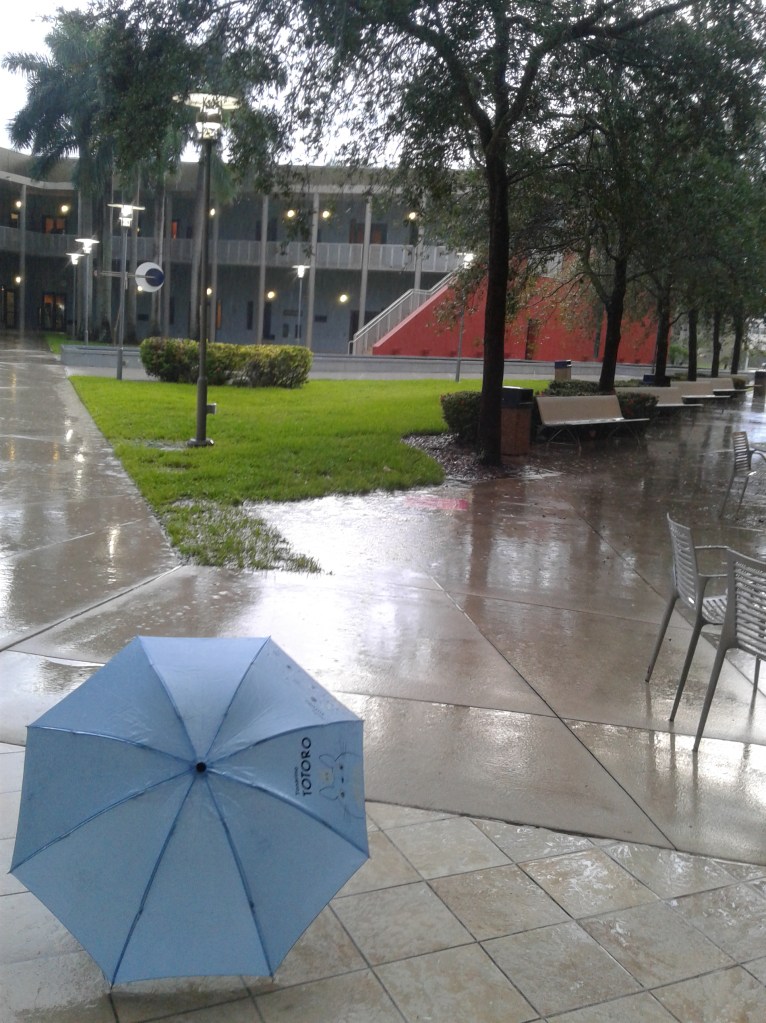
After the fun experience of writing blogs from Trinidad, I have pondered if and how to continue writing, but it felt as if there was not much to say. I have been back in Miami for over four months now, and life has been busy. I am back teaching, which is quite amazing, because I have not been in a classroom with students for about 2 ½ years, and I can tell you, it is a physical experience to teach face to face. Since I have been out of practice, it was particularly noticeable.
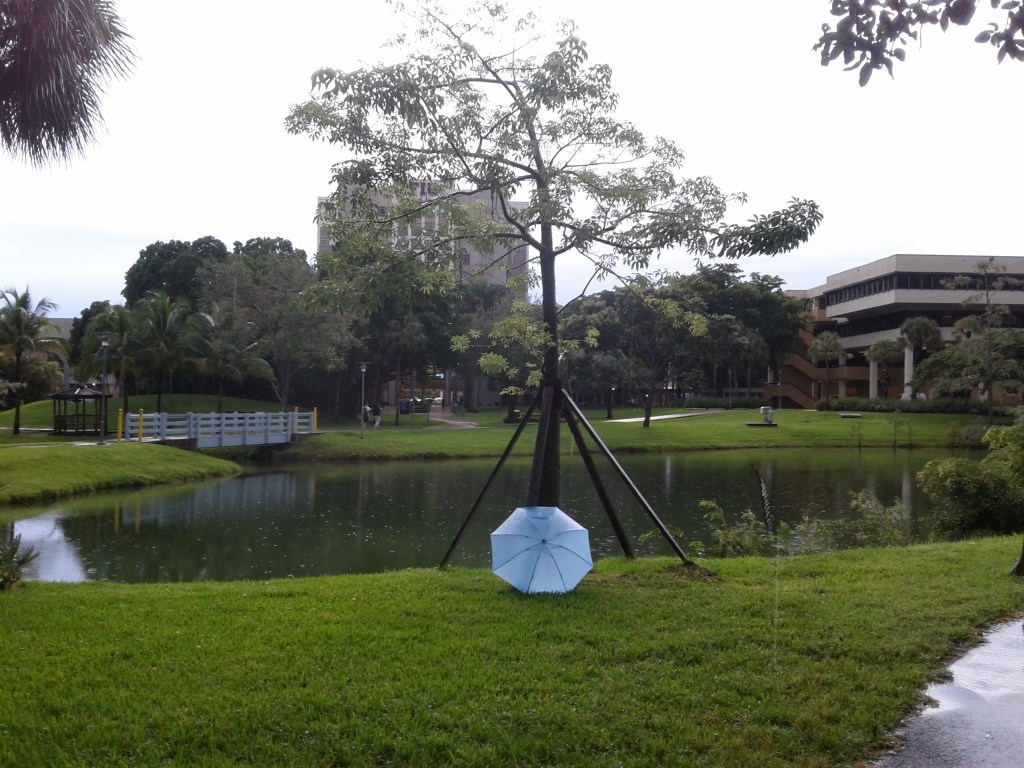
I’ve had a great year off. The Sabbatical allowed me to get off the grind, do things that I am passionate about in my own speed, and of course, I had this wonderful opportunity to get to know a new country, Trinidad and Tobago. The past year has allowed me to find my voice again, which I had lost somewhat before, and I am confident I will use it more often. Also, as you can see in the photos, taken this morning shortly after a massive downpour, FIU’s campus is beautiful – the vegetation of South Florida is right there (also some fauna, but hard to see).

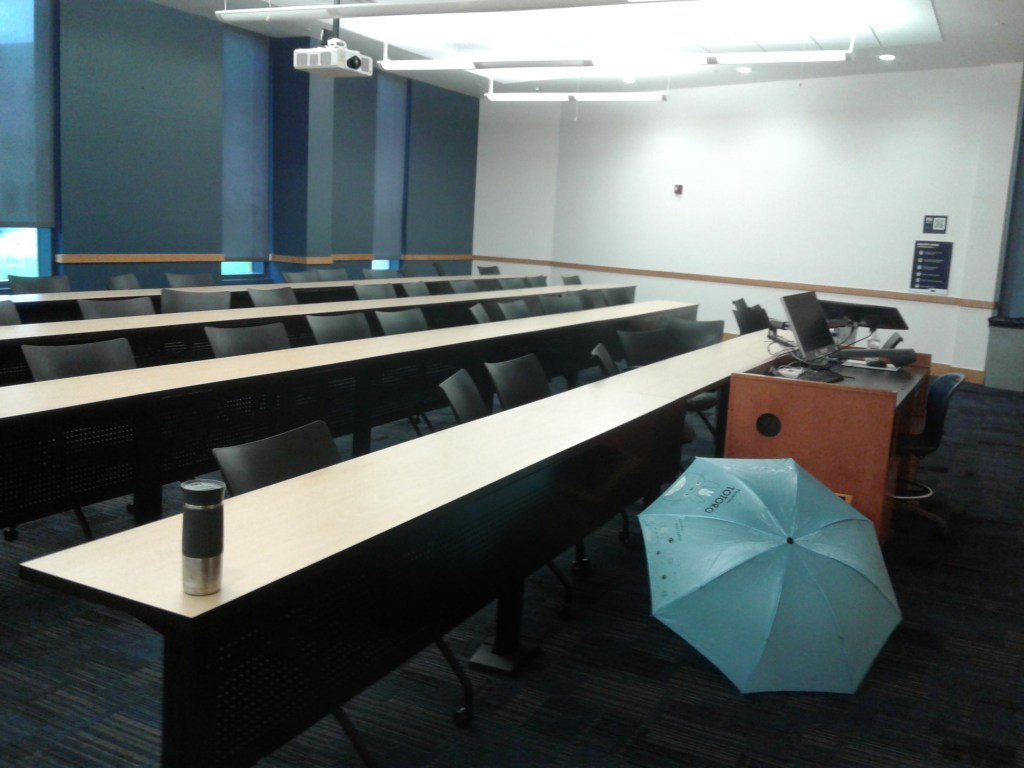
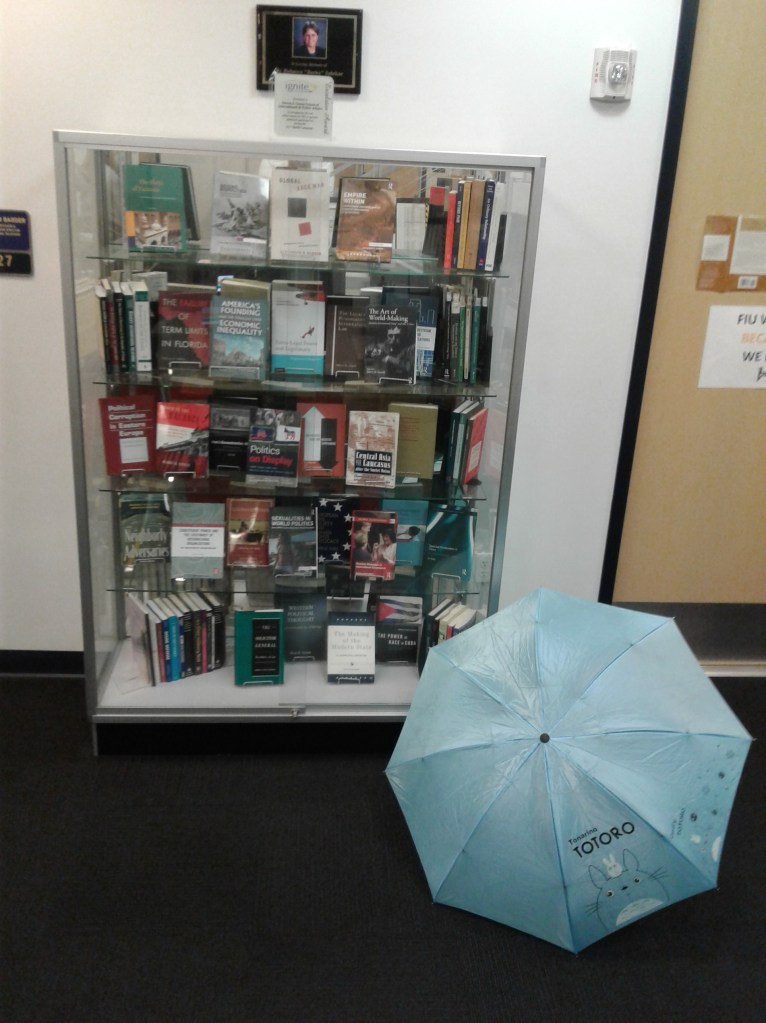
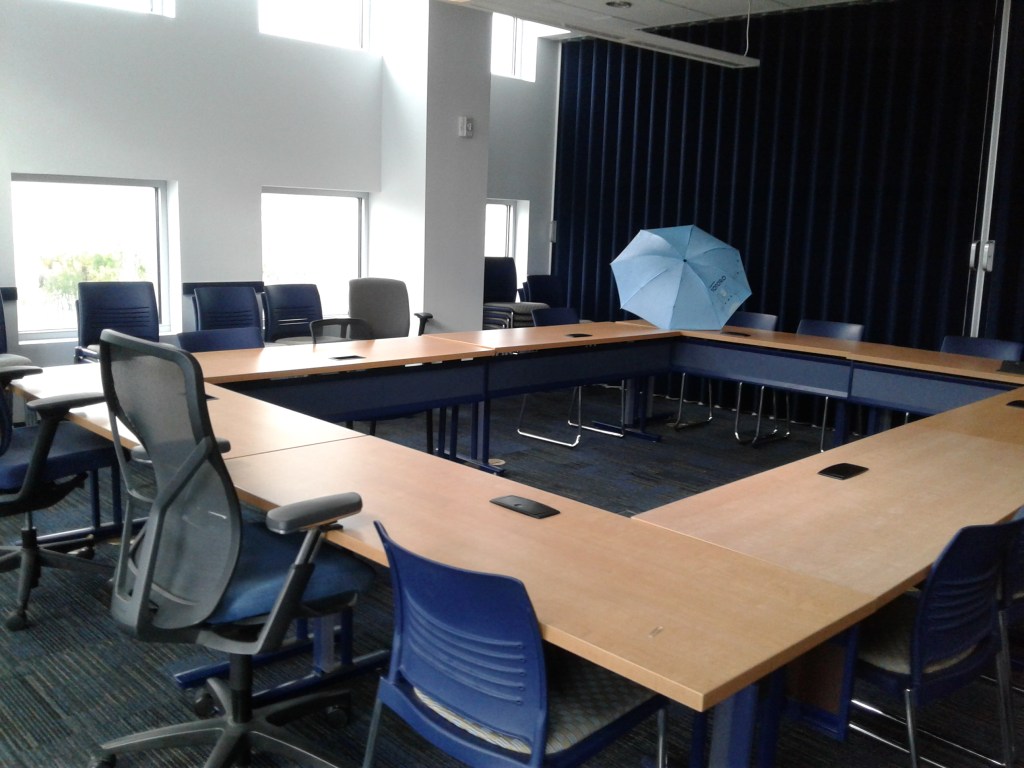
Here is also a glimpse of my classrooms. I am teaching one undergraduate and one graduate class this semester, both in my fields of interest (Gender equality and human rights in global perspective, and Feminism and IR) – for both, the first week has been lovely. The other snapshot shows our departmental “bookshelf”.
Last week, our phenomenal staff organized a Welcome back event for Graduate students. This is traditionally also the first occasion in the semester for faculty to mingle – again, I had not seen several of my colleagues as physical beings for over two years. One of my colleagues who to my delight really LOVED my blog told me that I should keep writing it. I felt flattered. So, Felix, because of your encouragement, here is my next try. THANK YOU.
I think most of you, both inside and outside of Florida know that there is always something going on here. Yes, often things that deserve an eye roll. And indeed, there is something that makes my eyes roll – it is called HB 7. HB stands for “House bill”. This is a Florida Law which according to the website of the Florida Senate “includes provisions designed to protect individual freedoms and prevent discrimination in the workplace and in public schools”. “Public schools” includes public universities. In order to protect freedom and prevent discrimination, the bill prohibits faculty to say and do certain things. I am pointing this out up front because usually, such a move would be discredited by Republicans (the Florida legislature is dominated by Republicans) as “cancel culture” or something to that effect.
What is it that we are not allowed to say or do anymore? I find it rather unclear. It is a very confused and confusing law. The people I have conversed with about this law mostly agree that this is the point – the content is so confusing that people are getting confused, but also scared, because it is hard to determine if your teaching actually violates this law or not. For some, this will lead to self-censorship. To be on the safe side. And there are two forms of self-censorship, individual and institutional (we are getting emails with guidance from our administration – they are worried they might lose state funding if they don’t set up the right procedures).
This law also seems to drum the same beat as earlier ones for K-12 public schools (those exclude universities). These laws affect the way teachers in elementary/ middle school are allowed to talk about sexual orientation (they are not allowed anymore) and how teachers in middle/ high school are supposed to teach American history (without reference to critical race theory – which is really only one way among many to critically investigate race relations in this country). These laws contain a major difference to HB 7: they rely on “parental rights” as K-12 students are minors. In other words, if a small number of parents can be mobilized to protest against things said by teachers or in schoolbooks, apparently their opinion counts more than the knowledge of the teachers and the schoolbooks. We are in a situation where teachers are seen as radical indoctrinators, never mind that they actually studied what they teach for quite a while. But those who have the power of definition on this are parents of any knowledge level as long as they are LOUD about it. Mind you, most parents are generally fine with how their kids are schooled but have probably some kind of minor criticism (I would count myself in this category and I do sometime make my voice heard – via letters to the principal; thus far, no law has been changed because of that). The Florida parents who are heard by the legislature are a minority, and in my view, they are extremists. For themselves, they are the defenders of truth and liberty. Their critique usually concerns issues of sexual orientation, gender identity or sex education – and because there are things they don’t want to hear, teachers can now not say them anymore, no matter how marginal to their actual teaching that is (the state has banned MATH textbooks – no joke, just Florida – that had some unacceptable text passages).
Now, HB 7 expands this challenge of what should and can be publicly taught to universities (because after all, this is where teachers and many others get indoctrinated – that must be the logic). HB 7 focuses on this class of attributes: “members of one race, color, national origin, or sex”. This sequence is repeated throughout the law. Among other things, teachers/ professors cannot teach that: members of one [insert sequence] are morally superior to members of another [insert sequence]; a person, by virtue of being [insert sequence] is inherently racist, sexist or oppressive; a person, because of [insert sequence] “bears responsibility for, or should be discriminated against or receive adverse treatment because of, actions committed in the past by other [insert sequence]”. Perhaps the most referenced part of what this law prohibits is to suggest that: “A person, by virtue of his or her race, color, sex, or national origin, bears personal responsibility for and must feel guilt, anguish, or other forms of psychological distress because of actions, in which the person played no part, committed in the past by other members of the same race, color, national origin, or sex.” Emphasis added.
Several things: First, the terms used are strange. I looked into the drafting process of the law. “Race” and “national origin” were always in there, but “color” replaced “ethnicity” and “sex” replaced “gender”. I would like to know why but have not seen an explanation anywhere. My suspicion is that the term “color” associates better with “white” than “ethnicity”; accordingly, one should be prevented to speak about “white anything” (supremacy comes to mind). But I am guessing. As for sex and gender: it is an old standpoint of religious conservatism (the Vatican started that in the early 1990s) that the term “gender” needs to be avoided because somehow it includes flexibility in all things heteronormative and may legitimize homosexuality. However, in the context of social science teaching, gender means that in relation to biologically formed human bodies (that is what “sex” describes in reference to reproductive capacities) societies create roles for and assumptions about these sexed bodies that vary significantly. Based on this distinction, social sciences look more specifically into the social construction of gender. That is what I do when I teach. Perhaps I could feel off the hook with this law because I don’t teach very much specifically about “sex”. However, it is clear that the point that this law (and the entire position of contesting gender) aims to make is that there is no such distinction and biology determines who we are, end of story. Anybody who does not agree with that is a threat to [insert accordingly] – the family; freedom (??); America …
Secondly, many things described in this law are not part of a university classroom, at least not mine. I spend a good amount of time helping students understand that they are, as individuals, embedded in social structures. That these structures influence who they are, and which values they have, but that structures do not determine individuals, also because structures are dynamic and typically change over time, and if they don’t change, then a lot of work has been put into maintaining them. Who does this work of change and stability? People. Hence, there is a relationship, we call it “mutually constitutive” between individuals and social structures. In this mindset, the personal responsibility or even “guilt” for things that happened in the past is not really a thing. What is a thing is to learn about societal developments, which include achievements as well as dark moments. This will help students make thoughtful decisions in the present and the future.
The point about “psychological distress”: I told my two classes last week that while I don’t aim at producing distress in anybody, it is not possible to avoid this to happen. If we learn things we had not been aware of, things that force us to challenge our assumptions – that could indeed cause distress. But I think that this is precisely why students attend universities. To learn new things, some of which could cause this kind of – I think productive – discomfort. When I said this, I saw a lot of people nodding their heads. And that is actually my biggest hope in this situation: the students. They are here to learn and to expose themselves to new knowledge that inspires and sometimes also challenges them.
The fact that I am now pondering the question if I should even make this post public tells you what is going on in Florida. Encroaching intimidation. Should I not do it because it could have negative repercussions for me? Let’s say this: I am not in immediate danger of being fired, because I have tenure (but that is also an institution that is slowly being chiseled away). Others feel much less protected. Also, as a feminist who teaches gender studies, I feel awkwardly affected by the law – on the one hand, critical gender studies seem targeted, but much less so than anything to do with race or sexual orientation/ identity (not saying that I don’t focus on either, but I assume this is less visible for someone looking superficially). In a way, the law does what is often done to feminism: it is silenced, made invisible, made unimportant. This time, this could be an advantage. It could add a layer of protection.

We will see what will happen. The commonsense feminist in Florida is ready to comment. Also, for my imminent birthday, I asked George to get me a coffee maker for the office, because after such a long absence from campus I can simply not stand the long lines at Starbucks anymore (to wit, “long” means the time it takes to get coffee, even if not many people are queuing – as everybody has to make 200 choices about their cups of coffee!!). So, if you are in or close to SIPA 4th floor and feel the need for a cup of coffee and/ or a chat, please knock on this door!
 The common sense feminist
Thank you for sharing your insightful views about “normal” life and important angles, often overlooked in our hurried world. I loved the introduction and topic. Nonetheless, nothing beats the clever way you showed us your presence via the light-blue umbrella that appeared to call our attention to your physical return to FIU. Keep writing!!!
LikeLike
Thanks, Felix! I will do my best 🙂
LikeLike