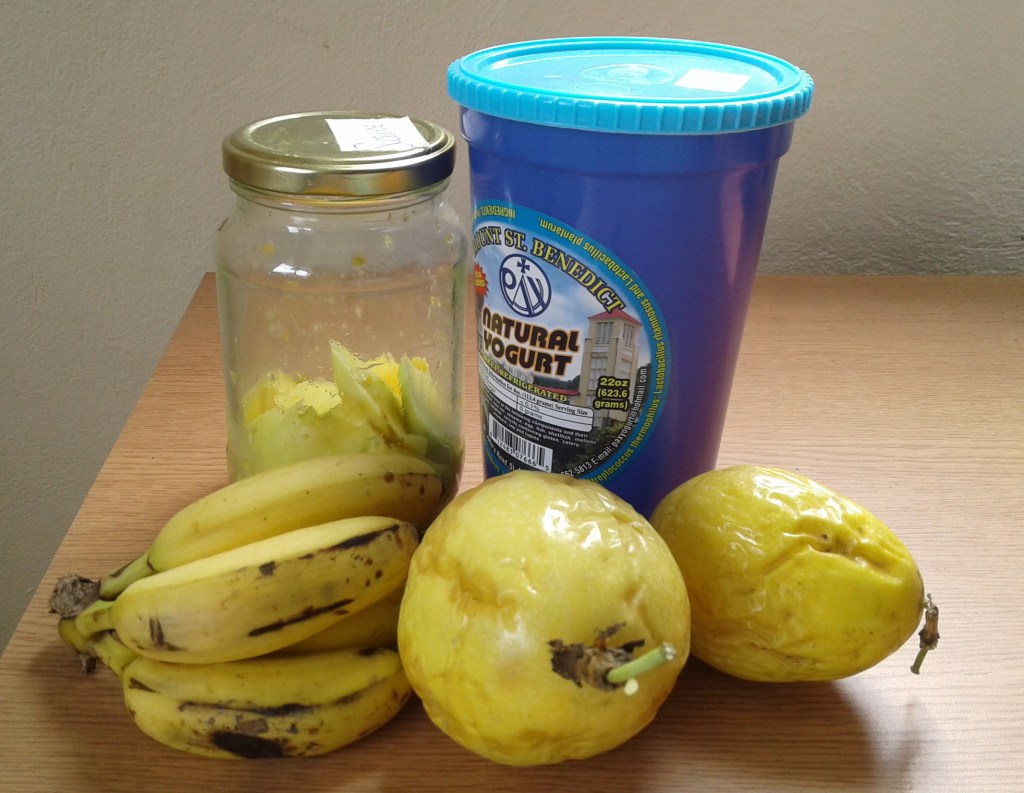
When I was savoring my weekend breakfast, my gaze fell on a little arrangement on the table: a glass container with mango marinated in pepper sauce (my creation but modeled after what is called “chow” here, a way of marinating fruit of your choice in savory/ spicy ingredients), a couple of baby bananas – also called chiquito fig, very nice and sweet – and two passion fruits. You probably have all had passion fruit in juice form, but did you know what the fruit looks like? Very unassuming yellow balls. They are also really light because there is not much inside. In any case, I look at this still life in yellow and am reminded of the blue and yellow initiative I wrote to you about recently (https://blue-and-yellow.de/ ) that posts photos with these two colors taken in solidarity with Ukraine. I have walked through the streets here thinking about this color frame, and now I was reminded of it again.
I had the yellow, but what could be the blue? I found the blue yoghurt container in which the monks of the Benedictine monastery up the road sell their yoghurt. This yoghurt is sold in local supermarkets and is excellent. Recently, a lady who knows things about this monastery told me that the monks are getting really old, and there are fewer of them than before – no younger monks are joining them. The yoghurt is one of their sources of income. I really hope they are holding up. It would be such a shame if that monastery would have to close. In any case, let me know what you think of my photo (I sent it to the website, and it is now posted there! Perhaps you also want to get creative and/ or donate some money – it goes to UNHCR).
Let me say a few things about Trini food. Considering that food is the basis of all life, making and sharing food is perhaps the most peaceful thing one can do. And don’t we all need a reminder that there are not only seeds of war, but also of peace, CONSTANTLY present in humanity.
Climatically, Miami is not very far away from Trinidad, but I have seen many fruits and vegetables here that are unknown to me. A few weeks after my arrival, I found an organization called the Alliance of Rural Communities (ARC). Really cool people. They grow organic produce in two sites (Brasso Seco and Grand Riviere – I hope to visit the latter soon!), and they specialize in chocolate making, meaning they grow the cocoa beans AND make the chocolate. This might not sound special to you, but it is. Typically, chocolate production implies a long chain of steps that the countries in which the cocoa is grown don’t have much to do with. Classical colonial division of labor, in the sense that the raw material is produced where the climate allows; in the case of cocoa, a labor-intensive process of getting the beans out of the pods then follows; and then, they are shipped away to where the “surplus value” is added to the beans, or in other words, where the profits are made. The two ARC cooperatives in Brasso Seco and Grand Riviere make the chocolate on site – you can also get a tour which is called “from bean to bar”. I talked to one woman who leads this effort, and she has created a network of cocoa growers in several Caribbean and African countries. They meet on zoom, exchange practices, and taste their respective chocolates. She told me that many of these people are the FIRST ones in their countries to actually make the chocolate bars. It is hard – there is no infrastructure; the market is difficult to navigate for sure, given the competition from giants like Nestle. But they are trying to do this, and in Trinidad, the conditions seem to be a bit better for doing it than elsewhere. I bought some of their chocolate (see one bar on the photo below). It tastes GREAT, even if really different from the chocolate that I am used to.
ARC grows other products as well, and you can order them online. Once a week, they bring all of this to town, luckily in walking distance from where I live. I usually order a “small box” – CSA (community supported agriculture, as it is called in the US) customers know the logic: you get what is currently harvested rather than what you particularly want. That brings the price down somewhat and gives the farmer stability. When I go and pick up my produce, I always have a nice chat with whomever is at the Café where the produce is delivered, and I always ask what is what. Here, for example, on this photo of the content of my first purchase
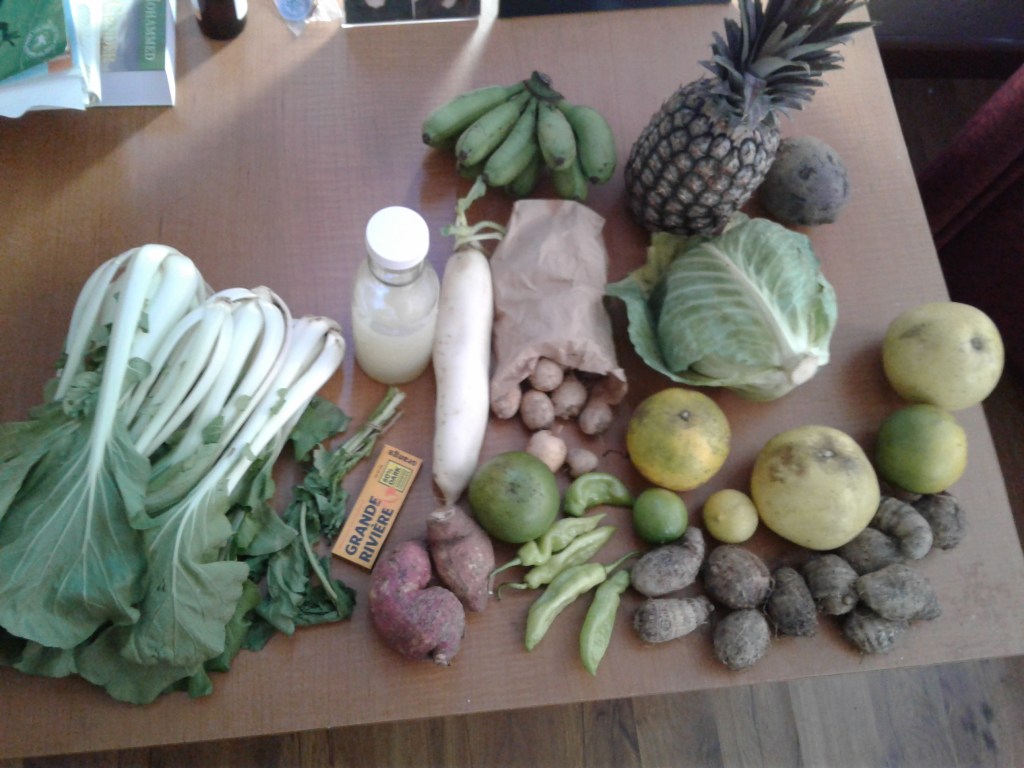
you probably see a lot of things that you know – pineapple, baby bananas, cabbage, bok choy, grapefruit, etc. But the small brown things in the paper bag? They are called tippi tambo and are roots. There are MANY roots here, aka “ground provisions”. On the photo, there are sweet potatoes that fall into that category (the red tubers next to the chocolate bar) and the brown ones on the right are called eddoes. They taste a little nutty – yummy.
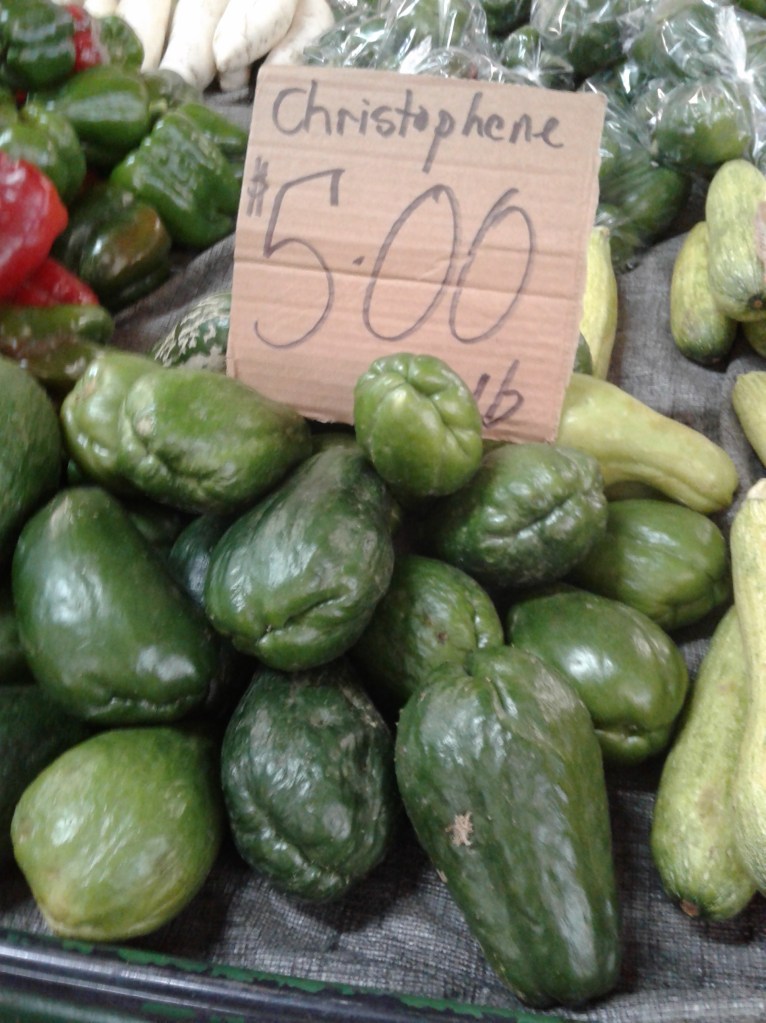
I also learned about this vegetable – Christophene (photo taken at the market). It is very mild and good in taking on all kinds of tastes; a bit like zucchini, perhaps.
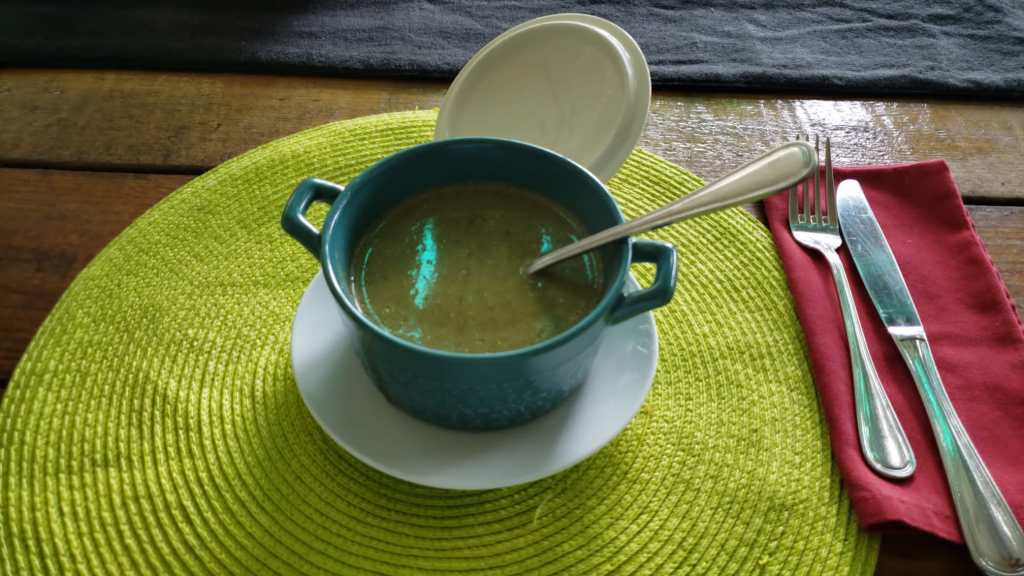
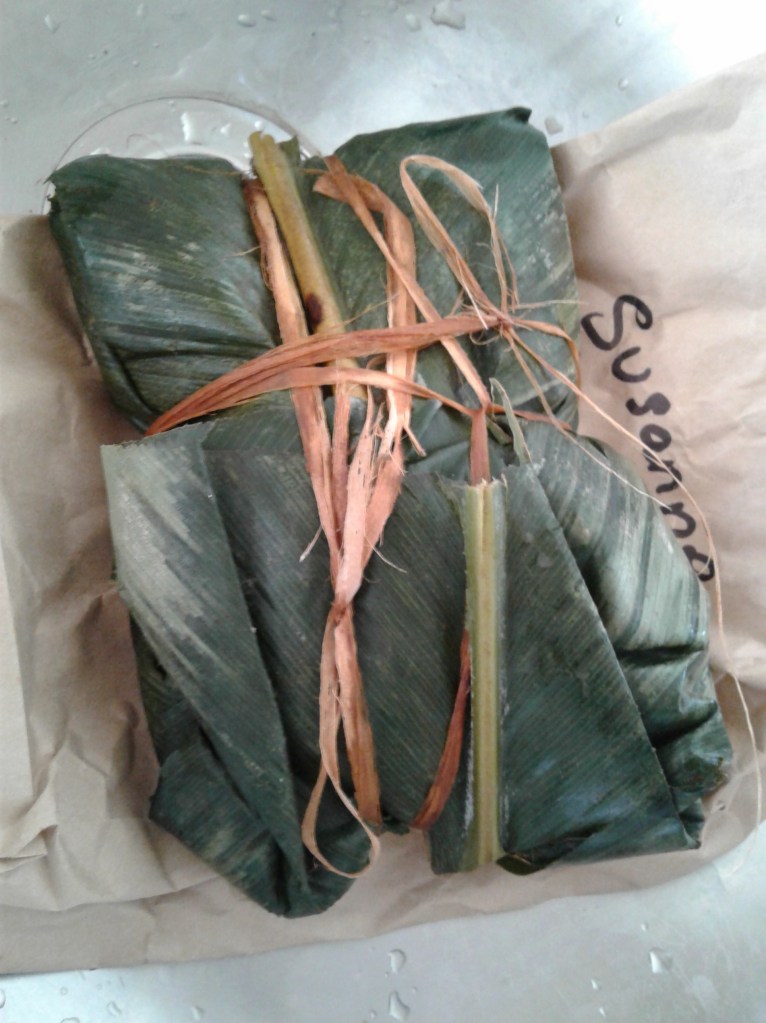
What I often do is order some additional things that they prepare, for example, callaloo soup, based on the leaves of the dasheen bush (similar to taro in Hawai’i; the roots can also be eaten – this super food has been an important component of Caribbean diets over time). ARC also has home-made ginger beer (love it) and once I also got myself a portion of veggie stir fry which was nicely packaged in a banana leaf. ARC also pride themselves in NOT using plastic wrappings. Totally my taste!
There are many indigenous plants, and of course history also creates particular pathways for how people feed themselves. For example, I learned that the Spanish in their early years here wanted to cultivate wheat, but it did not grow. Bummer. Rice is a staple food that first had a tradition as wild (red) rice in the south of the island where it was grown by Amerindians. Later, in the 19th century, the indentured laborers from India brought their rice-based diet with them and added large scale rice cultivation to the foods that were already consumed.
Slavery – if you recall, a bit less relevant for everything in Trinidad than in other Caribbean islands, because it did not last as long – also influenced diet. Eric Williams and also Sidney Mintz write about that. In order to feed the enslaved their owners a) allowed them to work little plots of land for their own consumption (so, extra work for them, but also improvement of diet and some independence, because they could sell produce; and reduced feeding responsibility for the owners) and b) provided the cheapest food sources that still enabled the hard physical labor. One of the ingredients was dried/ salted cod fish from Newfoundland. It feels like this must have been expensive because so far away (and how about fish from right around the island??). However, it fitted well into the transatlantic triangular trade at the time, because a) salted fish was already used to feed sailors and b) there was an intense transatlantic fishery economy, I think of mostly Portuguese fishermen, who went to Newfoundland and brought the fish back to Europe. Because the fish up there was abundant. One consequence of this is that to this day, salted cod fish is important in Caribbean cuisine.
There were other ways for protein intake as well. My friend Deborah took me out one Saturday evening to try souse. It is very popular street food made from chicken or pig feet, marinated with cucumbers in lime juice, onion, and peppers. You do not want to see a photo of it – I had chicken feet, and they looked like they had been in that marinate for a long time … grey-ish, a bit like gum. I tried it, and while it did not taste bad, it was really hard to get used to the rubbery texture. Deborah said that the origin of this dish lies in times of slavery when people ate anything they could make digestible.
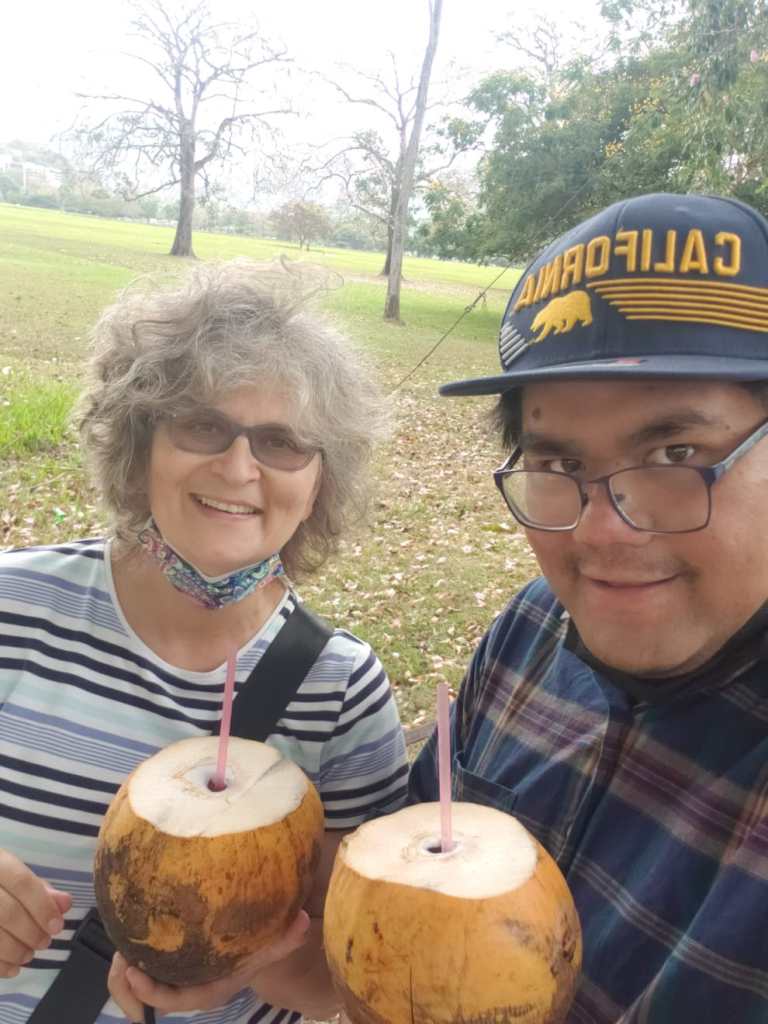
Speaking of street food: there are also street drinks, in particular coconut juice which I am enjoying here with Fed, one of my Fulbright friends. The top is chopped off and you drink the water; then, you give the nut back to the vendor, and they cut it open for you so that you can eat the meat as well.
Other strong influences in the diet come from Venezuela; for example, pastelles are a very popular dish. You may know it as tamales. It’s cornmeal filled with cooked, seasoned meat plus seasonings, then wrapped in a banana leave and steamed.
The two most specific Trini dishes – the ones that you REALLY have to try when you are here, apart from bake and shark – are doubles and roti.
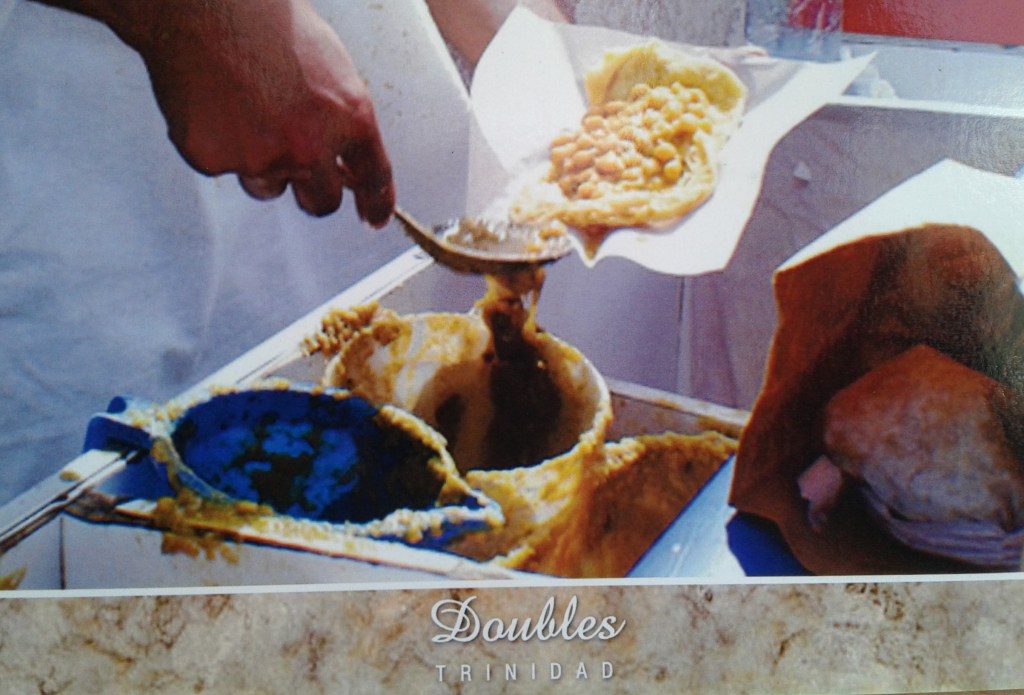
Doubles are supposedly a breakfast dish, but people eat it all the time and they are sold in the streets like hot dogs in New York City. A double consists of two pieces of flat fried dough, curried chickpeas (they are called channa here) and come with several toppings, like tamarind, mango, cucumber and chutneys. I like it but am not crazy about it.
The second one is roti – the basis of roti is a kind of dough and there are two types (you will be lectured on this by well meaning people). One is soft and flaky, and the other one is filled with split peas. Both types of dough – they feel a bit like a large piece of fabric that is folded – are then filled, and that filling can be about anything as long as it is curried. Veggies. Meats. Chicken. Duck. Shrimp. Lobster. I find it a messy dish to eat, but I love the taste! Also, my Fulbright friend Dylan who is a Trini says “everything that walks can be curried”. You see the possibilities are endless.
In a nutshell, Trini food is GREAT, as it seems to me is always the case where many cultures and their culinary traditions mix.
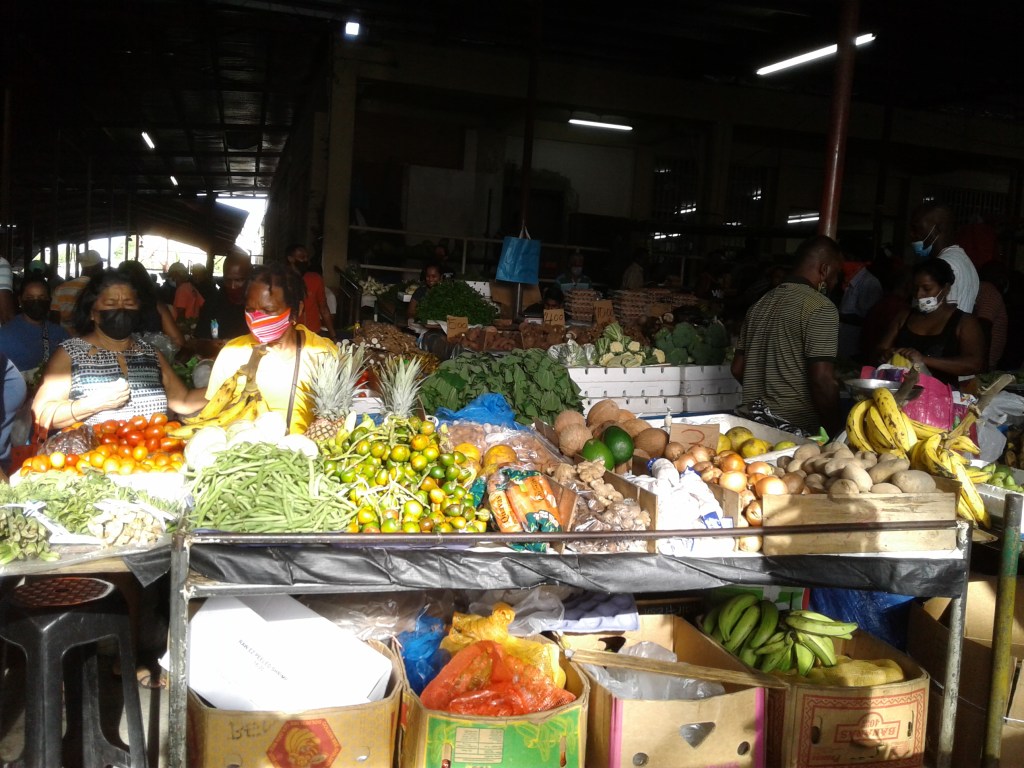
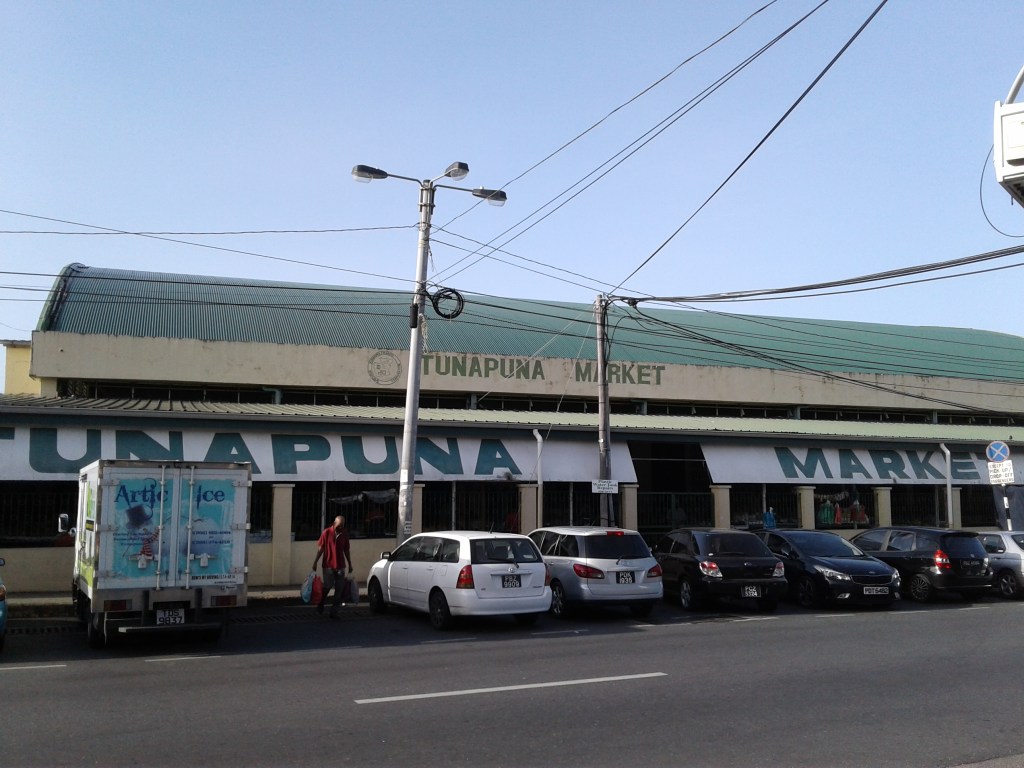
Apart from ARC, I also love to go to the local market in Tunapuna. I ask the vendors if they sell their own products or not. Sometimes they do, and sometimes, they buy. Avocados are rather pricey, I noticed, but REALLY cheap is bok choy, shallots, bananas, and peppers.
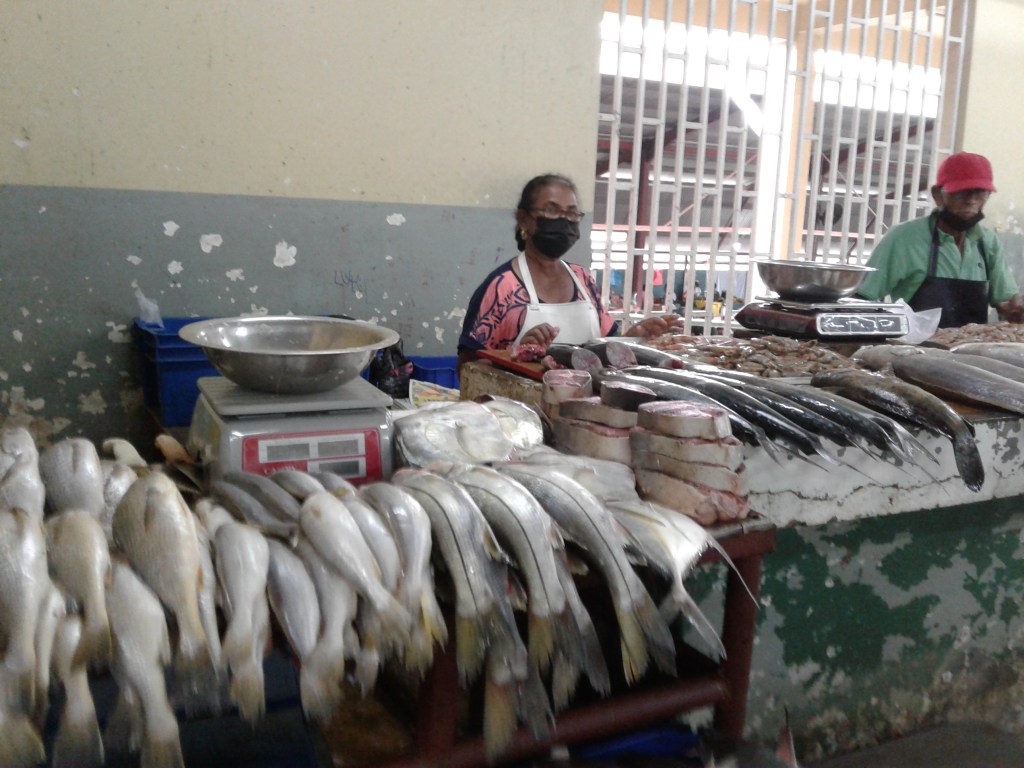
The fish vendor allowed me to take a photo of her and her amazing array of fish! I found the different kinds of fish being sold beautiful and could not bring myself to buy any. In the non-veggie part of the market, they also sell meat – I saw goat heads, pig feet, cow or pig sides … and a lot of energetic men loudly chopping whatever bloody piece of animal was on the chopping block. I think I moved a bit closer to full vegetarian again 😊.
 The common sense feminist
Suzanne! I love your posts. I save them
For that end of the workday time when you want to relax. The last one on food was my fav by far!! So thank you for including us in your adventure. You may be far away but your posts bring me closer to you.
Keep on truck’n!!
LikeLike
Dear Amy, very happy to hear this! I do feel the connection. Looking forward to a f2f meeting soon.
LikeLike
Thank you for lifting the secret of salt fish!
LikeLike